This blog is my attempt to record for my kids (and those that might be interested) the "first principle" lessons I've learned in life. I define "first principle" as those truths that remain regardless of situation, environment or timing. As I'm human, I will inevitably make mistakes in assessing and capturing these. That's the first first principle. ;-)
This chart, courtesy of the Bank of America, shows how massive the Bitcoin bubble was by the end of 2021. This is one more indication that the phase the crypto market is going through is ultimately healthy. Unsustainable projects are failing, and the Bitcoin bubble is bursting. What comes next? Hopefully, increasing experimentation, learning from mistakes, and a less volatile market.
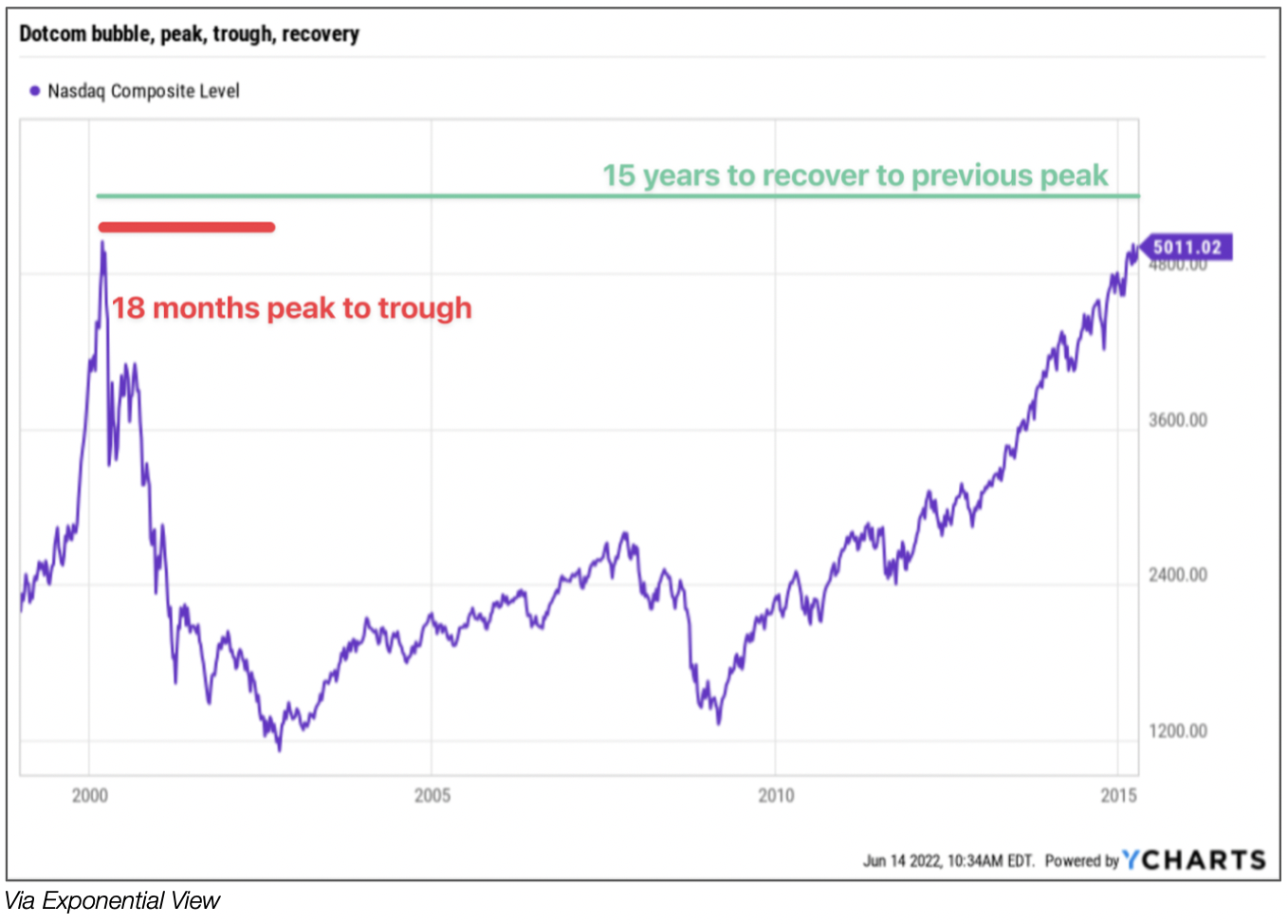
With the Nasdaq about 33% off its peak, it is worth remembering that during the dotcom bubble, the trough occurred about 78% below the March 2000 peak. And it took until October 2002 to get there. Recovery took a further 13 years.
“On the ground, a rock is just a rock. But when moving at high speed through the atmosphere, a rock becomes a meteor—alive with fire and burning bright.
People are not so different. Without activity, we are lifeless and dull. When moving fast and taking action, we come alive.” – James Clear
Stage 1—Unwind: It may still feel like the good times, but the seeds of the bad are starting to appear. Mini-narratives of bad times to come are proliferating.
Stage 2—Forced Capitulation: Positive narratives die and negative narratives reign supreme. Deleveraging spirals, layoffs, and company shutdowns.
Stage 3—Bottomless Exhaustion: Long, painful nothingness. No positive narratives or catalysts for improvement. Extended period of darkness.
Interestingly, the seeds of the bull market are often planted at the beginning of Stage 3 and begin to take form during that period.
My perspective is simple: If you can be a buyer when everyone else is a forced seller, you are positioning yourself well for long-term growth and success. Being a buyer can take any number of forms—it can relate to accumulating talent, building new ideas, or creating new opportunities.
During periods of prolonged darkness, this is the playbook:
Default Alive: Make sure your personal situation is “default alive”.
Long-Term Orientation: Play long-term games with long-term people.
Optimism: Realize that dark times never last forever.
Bias for Action: Boldly act on new and exciting opportunities.
Credit: Sahil Bloom from The Curiosity Chronicals.
“Show me the incentive and I will show you the outcome.” — Charlie Munger
Well-designed incentives have the power to create great outcomes; poorly-designed incentives have the power to…well…create terrible outcomes.
Goodhart’s Law says that when a measure becomes a target, it ceases to be a good measure. Simply put, if a measure of performance becomes a stated goal, humans tend to optimize for it, regardless of any associated consequences. The measure often loses its value as a measure.
One of the most prominent examples of this in action comes from the story of the British colonists’ cobra eradication efforts in India.
There were too many cobras in India. The British colonists—worried about the dangers of these venomous creatures—devised a plan to reduce the cobra population.
They started offering bounties for cobra heads.
Some savvy locals developed a business model:
Breed cobras
Chop of their heads
Turn in cobra heads and collect bounties
The British realized what was happening and ended the policy. Many of the breeders simply released their remaining cobras onto the streets, thereby increasing the population of cobras.
The British viewed cobra heads as a simple measure cobra elimination, so attached an incentive to deliver cobra heads. The result? An incentive designed to reduce the cobra population actually increased it.
Once you internalize this framework, you see it all around you:
Wells Fargo Account Opening Scandal: Senior leadership of the bank viewed new account openings as an easy way to track business growth, so it gave its junior employees target account opening goals. The result? Employees opened millions of fake accounts to hit their targets and Wells Fargo was fined billions for the fraud.
Amazon’s “Hire to Fire” Issue: Amazon believed employee turnover was healthy and had created a culture where the bottom 10% should be scrubbed annually in order to continue to upgrade the talent level of the organization.To incentivize healthy employee turnover rates, it gave its managers a target rate for annual turnover. The result? Media articles about a “hire-to-fire” practice emerged. Managers had allegedly hired employees they planned to fire in order to meet their turnover targets.
Credit to Sahil Bloom from The Curiosity Chronicle.





 First princples
You must be logged in to post a comment.